Tag

Fractional Dynamics

Browsing

Extended connectivity in graphs can be analyzed through k-path Laplacian matrices, which permit the capture of long-range interactions in various real-world networked systems such as social, transportation, and multi-agent networks. In this work, we present several alternative methods based on machine learning methods (LSTM, xLSTM, Transformer, XGBoost, and ConvLSTM) to predict the final consensus value based on directed networks (Erdös–Renyi, Watts–Strogatz, and Barabási–Albert) and on the initial state. We highlight how different k-hop interactions affect the performance of the tested methods. This framework opens new avenues for analyzing multi-scale diffusion processes in large-scale, complex networks.

Y. Ahsini, B. Reverte, J.A. Conejero. AI-Driven Consensus: Modeling Multi-Agent Networks with Long-Range Interactions Through Path-Laplacian Matrices. Appl. Sci. 202515, 5064. DOI:10.3390/app15095064


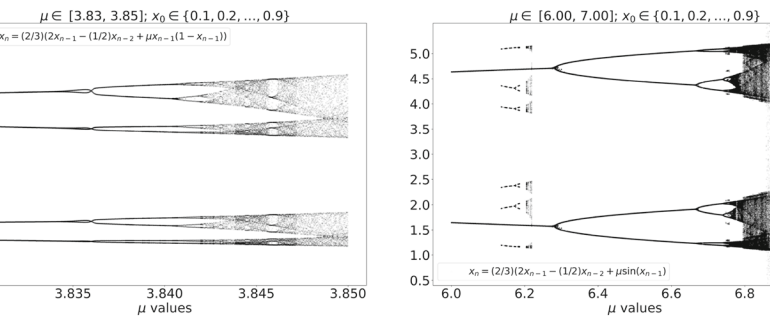
We show how machine learning methods can unveil the fractional and delayed nature of discrete dynamical systems. In particular, we study the case of the fractional delayed logistic map. We show that given a trajectory, we can detect if it has some delay effect or not and also to characterize the fractional component of the underlying generation model.

J. A. Conejero, Ò. Garibo-i-Orts, and C. Lizama. Recovering discrete delayed fractional equations from trajectories, Math. Meth. Appl. Sci. 48 (2025), 7630–7640, DOI 10.1002/mma.9228

A three-differential-equation mathematical model is presented for the degradation of phenol and p-cresol combination in a bioreactor that is continually agitated. The stability analysis of the model’s equilibrium points, as established by the study, is covered. Additionally, we used three alternative kernels to analyze the model with the fractal–fractional derivatives, and we looked into the effects of the fractal size and fractional order. We have developed highly efficient numerical techniques for the concentration of biomass, phenol, and p-cresol. Lastly, numerical simulations are used to illustrate the accuracy of the suggested method.

A. Akgül and J.A. Conejero. Fractal Fractional Derivative Models for Simulating Chemical Degradation in a Bioreactor. Axioms, 13(3), 151 , 2024. DOI:10.3390/axioms13030151