Author

J.A. Conejero

Browsing

Many of today’s problems require techniques that involve the solution of arbitrarily large systems Ax= b . A popular numerical approach is the so-called Greedy Rank-One Update Algorithm, based on a particular tensor decomposition. The numerical experiments support the fact that this algorithm converges especially fast when the matrix of the linear system is Laplacian-Like. These matrices that follow the tensor structure of the Laplacian operator are formed by sums of Kronecker product of matrices following a particular pattern. Moreover, this set of matrices is not only a linear subspace it is a Lie sub-algebra of a matrix Lie Algebra. In this paper, we characterize and give the main properties of this particular class of matrices. Moreover, the above results allow us to propose an algorithm to explicitly compute the orthogonal projection onto this subspace of a given square matrix A∈ RN×N.

J.A. Conejero, A. Falcó, M.Mora-Jiménez. Structure and Approximation Properties of Laplacian-Like Matrices. Results Math 78, 184 (2023). DOI:10.1007/s00025-023-01960-0

Large language models offer an opportunity to advance climate and sustainability research. We believe that a focus on regulation and validation of generative artificial intelligence models would provide more benefits to society than a halt in development.

In our recent work published in Nature Climate Research, we expose that the research and practice AI community has animated a lively debate around the moratorium request that was published in March 2023 to pause the training of very large AI systems4. Although we share some of the concerns that the signatories rightfully flag, we feel that the letter’s proposed solution to pause progress can be misunderstood to imply a broader halt on AI development by the policy community. Furthermore, the letter does not open a holistic debate about implications of this temporary halt for other scientific communities. We believe that the risk is that some countries, not aware of the full picture of this debate, may halt developments in AI altogether. As a result, research on key areas could be slowed down by a moratorium that limits a tool that has become essential to advance knowledge on complex problems with hidden interactions, such as climate change.

You can see our work here:
F. Larosa, S. Hoyas, J. García-Martínez, J.A. Conejero, F. Fuso-Nerini, R. Vinuesa. Halting generative AI advancements may slow down progress in climate research. Nat. Clim. Chang. (2023). https://doi.org/10.1038/s41558-023-01686-5

Taming the instabilities inherent to many nonlinear optical phenomena is of paramount importance for modern photonics. In particular, the so-called snake instability is universally known to severely distort localized wave stripes, leading to the occurrence of transient, short-lived dynamical states that eventually decay. This phenomenon is ubiquitous in nonlinear science—from river meandering to superfluids—and so far it apparently remains uncontrollable; however, here we show that optical snake instabilities can be harnessed by a process that leads to the formation of stationary and robust two-dimensional zigzag states. We find that such a new type of nonlinear waves exists in the hyperbolic regime of cylindrical microresonators, and that it naturally corresponds to two-dimensional frequency combs featuring spectral heterogeneity and intrinsic synchronization. We uncover the conditions of the existence of such spatiotemporal photonic snakes and confirm their remarkable robustness against perturbations. Our findings represent a new paradigm for frequency comb generation, thus opening the door to a whole range of applications in communications, metrology and spectroscopy.

S.B. Ivars, Y.V. Kartashov, P. Fernández de Córdoba, J.A. Conejero, Ll. Torner, and C. Milián. Photonic snake states in two-dimensional frequency combs. Nat. Photon. 17, 767–774 (2023). DOI:10.1038/s41566-023-01220-1

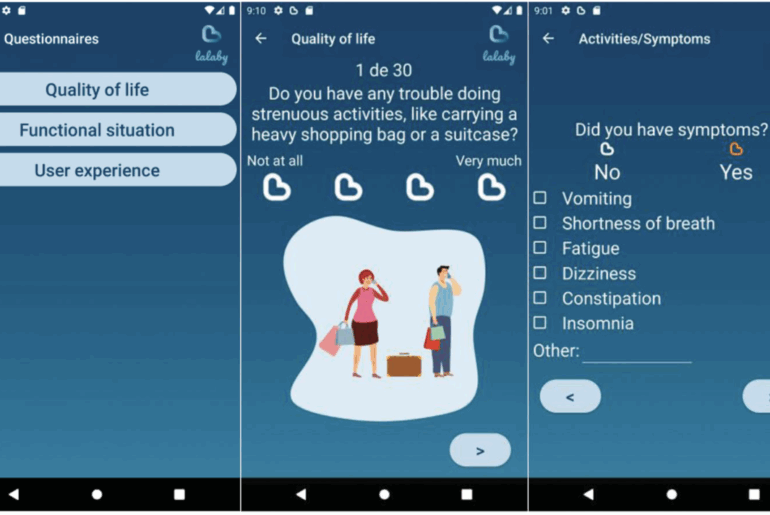
As there is now a growing interest in mHealth apps for cancer patients, we here present and test the Lalaby App to monitor lung cancer patients’ Quality of life (QoL) through mobile sensors and integrated questionnaires. The app was used in a 2-week study to register two lung cancer patients’ activity without problems or interruptions. The patients frequently reported activities, symptoms, and questionnaires, indicating their engagement with the app. They registered their experience through the UEQ-S integrated into the app. Patient 1 mainly reported a neutral experience, while Patient 2 found it highly positive. They considered the app leading-edge and helpful and would recommend it to others, while both patients valued it positively (3.72 and 4.64 on a scale of 1–5). The app’s aesthetics and its notifications helped their engagement. We found correlations between sensors’ data and patients’ QoL. We also detected QoL and functional status variations after treatment for both patients. After a “Tasks Test,” two oncologists assessed the app’s dashboard usability as excellent (SUS scores 85 and 87.5 on a 0–100 scale), easy-to-use and helpful. Their experience was positive (UEQ-S overall scale 2.81 (mean), −3 to +3 scale). The app allows monitoring the QoL of lung cancer patients remotely and in real-time while controlling patients’ experience to stop the use if necessary, avoiding overwhelm. © 2022 The Author(s). Published with license by Taylor & Francis Group, LLC.

S. Asensio-Cuesta, A. Sánchez-García, T. Soria Comes, I. Maestu, M. Martín Ureste, J.A. Conejero,  J.M.García-Gómez, J. M. (2022). Testing Lung Cancer Patients’ and Oncologists’ Experience with the Lalaby App for Monitoring the Quality of Life through Mobile Sensors and Integrated Questionnaires. International Journal of Human–Computer Interaction40(3), 640–650. DOI:10.1080/10447318.2022.2121561

On May 30th, I have participated in the Multiplier Event Teaching Data Literacy, showing experiences from the DaLiCo project. Here, we have presented some results of the different intellectual outputs of our project. We also have introduced the model that we have conceived for organizing summer schools on data literacy, with the showcases of Hamburg (2020) and Utrecht (2021). I also took part in moderating discussions on the implementation of data literacy into university curricula.

The Erasmus+-funded international project “Data Literacy in Context” DaLiCo focused on increasing the visibility, quality, and usage of existing Data Literacy activities at the participating universities. From September 2019 until October 2022 the project brought together four European Universities of Applied Sciences with the mutual mission to foster data literacy education: HAW Hamburg as the Coordinator of the project, Stichting Hogeschool Utrecht, University of Debrecen and Universitat Politècnica de València as partners.

The findings and outcomes of our project work are documented in five intertwining outputs:

  1. DaLiCo App, with integrated Glossary
  2. Train-the-Trainer Handbook and e-Learning Course
  3. Virtual Data Literacy Learning Space
  4. Assessment Instrument
  5. Concept for Implementing Data Literacy into Curricula

All results are available online and open accessible. We hope to stimulate discussion and give impulses for further developments into the data literacy community. The results are expected to have an impact beyond the project, as e.g. the DaLiCo summer schools, which will continue to be implemented by the partners as an extra-curricular activity.

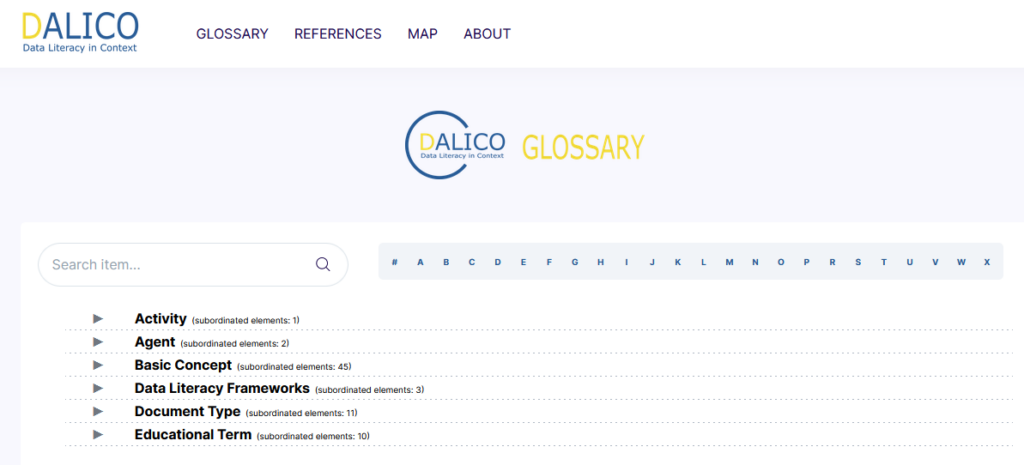
DaLiCo App is a searchable collection of references of data literacy resources curated by the DaLiCo Team. With a focus on resources on the topic of data literacy education the app provides entry points to learning and teaching materials, relevant educational frameworks and bibliographies on data literacy, as well as projects and experts at the partner institutions. The resources are keyworded with descriptors from the integrated DaLiCo Glossary. The DaLiCo Glossary is a collection of key concepts in the field of data literacy (education). It is structured as a thesaurus.

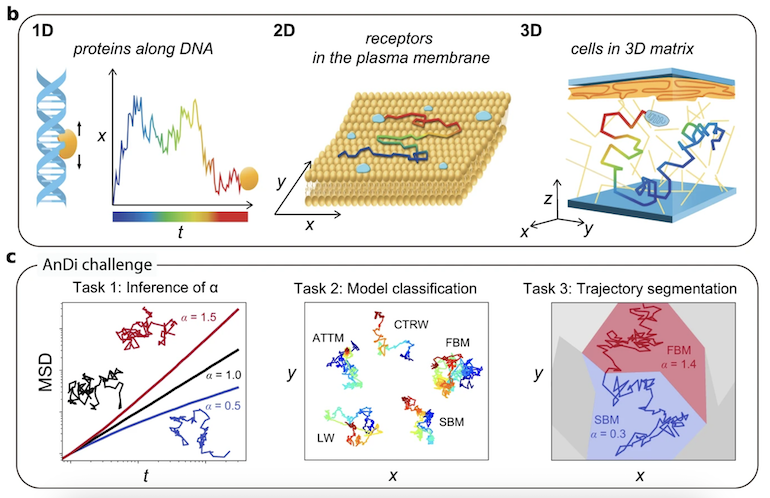
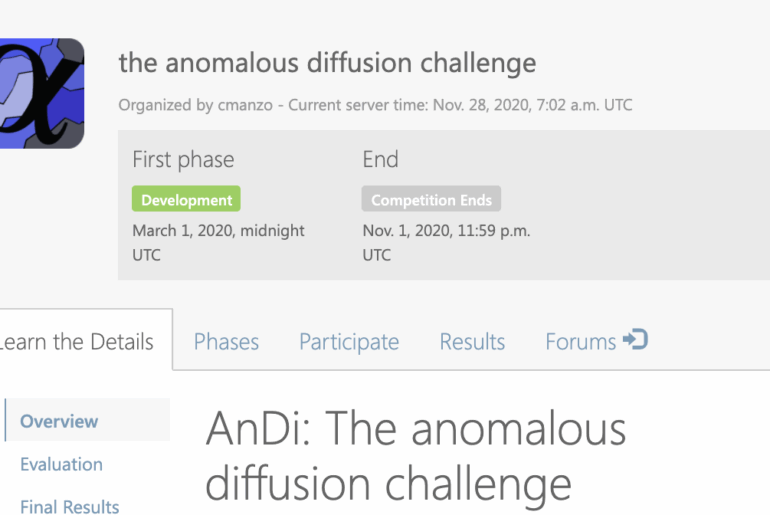
Deviations from Brownian motion leading to anomalous diffusion are found in transport dynamics from quantum physics to life sciences. The characterization of anomalous diffusion from the measurement of an individual trajectory is a challenging task, which traditionally relies on calculating the trajectory mean squared displacement. However, this approach breaks down for cases of practical interest, e.g., short or noisy trajectories, heterogeneous behaviour, or non-ergodic processes. Recently, several new approaches have been proposed, mostly building on the ongoing machine-learning revolution. To perform an objective comparison of methods, we gathered the community and organized an open competition, the Anomalous Diffusion challenge (AnDi). Participating teams applied their algorithms to a commonly-defined dataset including diverse conditions. Although no single method performed best across all scenarios, machine-learning-based approaches achieved superior performance for all tasks. The discussion of the challenge results provides practical advice for users and a benchmark for developers.

G. Muñoz-Gil, G. Volpe, M.A. Garcia-March, et al. Objective comparison of methods to decode anomalous diffusion. Nat Commun 12, 6253 (2021). DOI:10.1038/s41467-021-26320-w

Our team VALENCIA IA4COVID, coleaded by Nuria Oliver and me, has won 500k Pandemic Response Challenge, organized by XPRIZE Foundation and supported by Cognizant. The $500K Pandemic Response Challenge, required teams to build effective data-driven AI systems capable of accurately predicting COVID-19 transmission rates and prescribing intervention and mitigation measures that, with testing in “what-if” scenarios, were shown to minimize infection rates as well as negative economic impacts.

Our group is made up of fourteen experts from the Universities and research centers of the Valencian Community. Our model successfully forecasted epidemiological evolution through their use of AI and data science and provided decision makers with the best prescriptor models to produce non-pharmaceutical intervention plans that minimize the number of infections while minimizing the stringency of the interventions.

You can find the details of the prize here and of our model here .

During the last months, I have been participating in the ANDI Challennge, together with my Ph.D. student Óscar Garibo. Since Albert Einstein provided a theoretical foundation for Robert Brown’s observation of the movement of particles within pollen grains suspended in water, significant deviations from the laws of Brownian motion have been uncovered in a variety of animate and inanimate systems, from biology to the stock market. Anomalous diffusion, as it has come to be called, is connected to non-equilibrium phenomena, flows of energy and information, and transport in living systems.

The challenge consists of three main tasks, each of them on 3 Dimensions:

  • Task 1 – Inference of the anomalous diffusion exponent α.
  • Task 2 – Classification of the diffusion model.
  • Task 3 – Segmentation of trajectories.

We got the first position in Task 1 (1D) and the second position in Task 2 (1D). We also get the 3rd position in Task 2 (3d) and the 4th position in Task 2 (2D).

MOOC en edX: Aplicaciones Teoría de Grafos a la vida real I (MOOC)

MOOC en edX: Aplicaciones Teoría de Grafos a la vida real II (MOOC)

Este curso trata la Teoría de Grafos desde el punto de vista de la modelización y se ofrece en edX. Los contenidos nos permitirán con posterioridad resolver muchos problemas de diversa índole. Presentaremos ejemplos de los distintos problemas en un contexto real, analizaremos la representación de éstos mediante grafos y veremos los algoritmos necesarios para resolverlos. Resolveremos problemas que aparecen en la logística, la robótica, la genética, la sociología, el diseño de redes y el cálculo de rutas óptimas, mediante el uso de la Teoría de Grafos. Nuestro objetivo será presentar tanto los contenidos de la misma como la modelización de los casos planteados.

En cada tema comenzaremos presentando el problema a resolver. Posteriormente introduciremos la teoría y los algoritmos correspondientes, modelizaremos el problema propuesto y finalmente hallaremos su solución. En general explicaremos en qué consiste y cómo se deduce cada algoritmo, haciendo para ello una traza a modo de ejemplo.

Las unidades del curso son:

Unidad 1: Conceptos básicos de la Teoría de Grafos

Unidad 2: Accesibilidad

Unidad 3: Grafos ponderados

Unidad 4: Árboles

Los contenidos de este curso fueron reconocidos con una Mención Especial del I Premio Ministerio de Educación, Cultura y Deportes (España) – Telefónica L.S. – Universia a la iniciativa de MOOC’s en MiríadaX.

MOOC en edX: Aplicaciones Teoría de Grafos a la vida real II (MOOC)

Este curso trata la Teoría de Grafos desde el punto de vista de la modelización y se ofrece en edX. Considera la Teoría de Grafos desde el punto de vista de la modelización, lo que nos permitirá con posterioridad resolver muchos problemas de diversa índole. Presentaremos ejemplos de los distintos problemas en un contexto real, analizaremos la representación de éstos mediante grafos y veremos los algoritmos necesarios para resolverlos.

Resolveremos problemas que aparecen en la logística, la robótica, la genética, la sociología, el diseño de redes y el cálculo de rutas óptimas, mediante el uso de la Teoría de Grafos. Nuestro objetivo será presentar tanto los contenidos de la misma como la modelización de los casos planteados.

En cada tema comenzaremos presentando el problema a resolver. Posteriormente introduciremos la teoría y los algoritmos correspondientes, modelizaremos el problema propuesto y finalmente hallaremos su solución. En general explicaremos en qué consiste y cómo se deduce cada algoritmo, haciendo para ello una traza a modo de ejemplo.

En cada tema comenzaremos presentando el problema a resolver. Posteriormente introduciremos la teoría y los algoritmos correspondientes, modelizaremos el problema propuesto y finalmente hallaremos su solución. En general explicaremos en qué consiste y cómo se deduce cada algoritmo, haciendo para ello una traza a modo de ejemplo.

Las unidades del curso son:

  • Unidad 1: Emparejamientos en grafos
  • Unidad 2: Grafos Eulerianos y Hamiltonianos
  • Unidad 3: Redes y flujos
  • Unidad 4: Coloración y localización en mapas

Los contenidos de este curso fueron reconocidos con una Mención Especial del I Premio Ministerio de Educación, Cultura y Deportes (España) – Telefónica L.S. – Universia a la iniciativa de MOOC’s en MiríadaX.

OpenCourseWare (OCW) – Análisis Matemático (Calculus)

Aquí puedes encontrar los materiales en el Open Course Ware de la UPV de la asignatura de Análisis Matemático (1st & 2nd semester – 9,6 ECTS) que impartí desde 2000 hasta 2009 en la Facultad de Informática (actual ETS de Ingeniería Informática) de la Universitat Politécnica de València. Aquí tienes el programa.

  1. Unidad Temática 01. Números reales. Funciones reales de variable real
  2. Unidad Temática 02. Números complejos y funciones de variable compleja
  3. Unidad Temática 03. Sucesiones de números reales. Relaciones de recurrencia
  4. Unidad Temática 04. Series de números reales
  5. Unidad Temática 05. Integración
  6. Unidad Temática 06. Funciones de varias variables
  7. Unidad Temática 07. Series de Fourier
  8. Unidad Temática 08. Ecuaciones diferenciales ordinarias
  9. Prácticas